|

|
|
|
|
|
|
Louis
Kincaid - Biracial young cop, 1980s - Mississippi,
Michigan, and now Florida
Jump to these reviews: Paint it Black, Dead of Winter "Thicker than Water""I believe a man has a right to be believed until the evidence proves that he shouldn't be."
So when a guy approaches him during his dinner at the local hangout, at first he's annoyed (it is his 27th birthday), then at the thought of a paying case, interested, and then totally uninterested when the guy can only pay $500. With this kind of case, he can burn through that amount in a day. Ronnie Cade wants to hire Louis to investigate the homicide charges brought against his father, Jack Cade. Ronnie doesn't trust a court-appointed lawyer to care enough to save his father -- who just got out of jail and now faces murder charges for killing lawyer, Spencer Duvall. But that's nothing compared to the original charge that sent him to prison in the first place; Jack Cade pleaded guilty to the rape and murder of a teenage girl twenty years earlier. As much as Kincaid wants nothing to do with this case, Ronnie's plea does rub his soft spot; he can't overlook the emotion when Ronnie Cade says he lost his father for twenty years and doesn't want to lose him again. So begins Kincaid's first job working on behalf of the criminally charged rather than for the prosecution. To do this he knows he has to stop thinking like a cop -- the only profession he's ever really wanted -- and start believing in the innocence of a man charged with a crime. And he is supposed to look past the previous conviction. Though, he's not able to do this without first asking Jack Cade if he killed the girl twenty years earlier. And even if Kincaid is to believe that Cade didn't kill the girl and didn't kill Spencer Duvall, Cade isn't an easy man to like or to want to defend. Jack Cade is caustic and there's something bothersome about the man and his eyes. Nevertheless, as unpleasant as Louis finds this man (and eventually most all of the characters involved in this case), there are things that don't seem to add up. Like the fact that a rape and murder charge usually carries life imprisonment, if not, the death penalty. So how did Cade's lawyer get him such a light sentence and why would a man kill his lawyer for doing him this favor? Louis has a hunch that whatever happened twenty years earlier has a bearing on this case. At about the same time that Louis decides that he will take the job, Jack Cade's public appointed lawyer, a black woman named Susan Outlaw, comes to the conclusion that if she's going to keep this case, she'll need help. She can't stop Ronnie Cade from hiring Louis, but she can keep better tabs on him if the investigator is under her employment, or so she believes. For Louis this is akin to making an agreement with the devil; he doesn't like dirt bags and he doesn't like defense lawyers. But by this time, the twenty-year-old murder of Kitty Jagger is starting to nag him and getting paid to investigate isn't all that bad of an idea. Though Susan Outlaw has doubts about Kincaid and his cop brain, she has done her homework on him and senses that this is a man that works "with a different kind of compass" who won't cross certain lines. Turns out she's both right and wrong. |
|
||||||||||||||||||||||||||||||||||||||||||||||||||||||||||||||||||||||||||||||||||||||||||||||||||||||||||||||||||||||||||||||||||||
|
There is a lot I like about this series, but the thing that makes it stand out most to me is how the author is developing the Louis Kincaid character from one book to the next and how each time this plays into the plot. Louis is young and his past has influenced pretty much everything that he does. Truly the action that he took at the end of Dead of Winter has tainted his reputation with other cops -- and probably for good. Whereas in the previous novels, especially the last, the author plots around his biracial profile, and this duality is part of the plot motivation, in this novel, the author barely touches the race issue and instead works on how Kincaid thinks about the law. Up until now he believes that the cops are basically the good guys and defense lawyers are the scum. Though Susan Outlaw is quick to point out that Kincaid overlooks that cops aren't prosecutors -- meaning that cops aren't the whole picture when it comes to justice and the law. In a sense, Kincaid knows this, he's a pre-law student, so he isn't numb to the fact that a defense lawyer's job is to defend the law. So where does Kincaid fit into all of this these days? Obviously he's not wearing a cop's uniform, even though he still holds out hope that he will again. For now, he just knows he's a good investigator. And, as it turns out, Louis Kincaid is uniquely qualified to solve Spencer Duvall's murder because of his tendency to dwell on the past. In this case it's the original murder victim from twenty years earlier -- Kitty Jagger -- who motivates Kincaid to maneuver around the legal system to find out what happened then and now. I highly recommend this series, starting with the first book right up until this one. If you've been keeping up with this series, let me tell you, Thicker than Water will not disappoint. I don't know how the author comes up with such credible misdirection and so many. Each time it really seems that Kincaid is onto the final truth since, as the title indicates, there is a family tie implicated, but this plot just keeps on twisting and evolving. In the end, Kincaid does something that is bound to affect him in all future novels and it will be interesting to see how his moral compass plays out in the next book. Obviously this is the kind of series that not only grabs you while reading the latest book, but also has your attention even before the next book is written. Louis Kincaid's character has always been one of integrity, but as he gets older and wiser, his integrity gets a bit more complicated. Certainly he's the kind of character worth rooting for as he makes his way in the world. I just hope he stays in Southwest Florida awhile longer; as far as living vicariously, Captiva Island is surely up there as one of the places I most would want to live. (Reviewed by Judi Clark 01-20-03)
Read a chapter excerpt from Thicker than Water at MostlyFiction.com "Paint it Black"
During his initial interview with Tatum, Kincaid's background does have some bearing on the conversation, because he does understand about what she's saying about her fights with her husband meaning nothing, so he feels that Roberta was not involved in the murder. However, Sheriff Wainwright, whom Kincaid meets right after, isn't ready to give up on his key suspects claiming that she fits a pattern and assumes she put her brother up to it. Wainwright offers to take Kincaid out to the murder site and then, by chance, off to arrest Roberta's brother. It's at this time that we start to see Kincaid's inner struggle; he is wrestling with the fact that he's not a cop, but despite being out of a uniform, can't help but react as one. He still carries impressions from his last job when he argued with his partner Jesse, and fully believed himself, that he was not just a cop, but a man first. But maybe Jesse was right and if so, Kincaid's in trouble because he can't apply for a job without telling them what went on up north. The next day's newspaper contains an article about another murder; the victim is again a black man, but this one is an out-of-state businessman. Kincaid gives Wainwright a call and gets invited to the autopsy. So now Wainwright has two murders and a sparse number of suspects, and the South Florida NAACP is taking him to task for not treating these murders as hate crimes. Being short of staff and wanting to keep the case out of the hands of the politically motivated (and offensive) Sheriff Mobley, he decides to hire Kincaid as a "consultant" with some petty cash funds. To Kincaid's relief, no references are required. By the time the third murder occurs, Sheriff Wainwright concedes he needs real help; he knows that he's got a serial killer on his hands. He makes a call to his former employer, the FBI - where he worked before he took this "retirement" job, to see if an old friend can help out. To Wainwright's disappointment, (but to our delight) the FBI sends rookie Agent Farentino from Miami. Not that Wainwright has taken the time to find out, but she's fully qualified as the new type of agent that works for the FBI's recently created Behavioral Science Unit, what she calls a forensic psychologist, otherwise known as a profiler. Serial killer thrillers are not my favorite type of plot, though I realize that I'm clearly in the minority. As much as I like a good detective series, I dislike being directly in the mind of the killer. If I hadn't liked the previous Louis Kincaid novel as much as I did, I'm not sure that I would have continued with this novel past the first chapter. But then again, the second chapter takes us straight to Southwest, Florida, the place I really want to be. Oh, does this sentence make my eyes squint: "They were crossing a large open bay, and the confluence of water and sky was sudden and startling, like being injected into a sparkling, bright blue." That said I stuck with it because I like the Louis Kincaid character. He has a dogged personality whether working on the case or trying to make sense of his life, but ever mindful of the senior authority. As in the previous novel, the author cleverly has the plot twist back on the very thing that brings Kincaid to Florida, his race. So for a serial killer plot, it's pretty good and very smart. Setting the novel in 1986 is key to elements of the plot. It's at about this time that the FBI created profilers and old timers were still having a hard time with women taking on more professional positions. However, the dangers in writing a novel that takes place in the near past is that it is easier to slip up. Some of the math and dates bothered me. FBI agent Farentino says her parents never married yet were together for 35 years. I can accept that. However, she then explains that the reasons they didn't get married was a sixties thing and they died when she was a senior in college. Well that doesn't add up if the book takes place in 1986; it means her parents started to live together in the late forties. The other thing that is wrong is the calendar dates. The serial killings take place on Tuesdays. While investigating Louis ask where someone was on Tuesday, March 1st. However, March 1, 1986 is actually a Saturday. Later there's a reference to Tuesday March 14. March 14, 1986 is actually a Friday. Anyhow, this does not get in the way of the plot, but an editor should have caught this before it went to print. Even if I'm a little pickier with this book, as a whole I recommend the series and this novel; the plot twists are good and Kincaid's personal growth is just as compelling. P.J. Parrish has developed Louis Kincaid as a bit of a soul searcher. With his biracial heritage and having grown up as a foster child, he's at a loss as to where he belongs. While all the signs are there that he should just stay in Florida, he keeps thinking that he's going back to Michigan. Not only does it turn out that FBI Agent Sarentino is good at her job, she also helps teach him a thing or two about making your own place. I'm relieved to see that the author has decided to let Kincaid stay in Florida for awhile; I really do want Louis to find a place to stay as much as I want to keep revisiting this part of Florida. (Reviewed by Judi Clark 02-21-02)
Read a chapter excerpt from Paint it Black at MostlyFiction.com (back to top)"Dead of Winter""Gens una sumus."
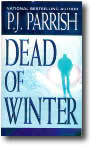
So after a fifteen minute interview, Kincaid is hired and is sworn in on December 20th. He's a little uncomfortable that he might have been hired because he's black, like Pryce. But then again there are a few other uncanny similarities, like he's the same uniform size and also takes three sugars in his coffee. As he's riding with his training officer, Jesse Harrison, he finds out that Pryce was the department's Investigator, like Kincaid was in his previous job. Kincaid takes these signs as just another reason that Loon Lake feels right and could be the place that he decides to call home. What's more, after only a few days of living there he has a chance meeting with a woman and it looks like he might have found someone special to with whom to get romantically involved. His new boss is a bit unconventional for a police department Chief. He plays chess, quotes literature and other sources to explain his philosophy and generally seems to value intelligence. Kincaid thinks that perhaps one reason Chief Gibralter hired him is that he has a college degree. At any rate, Gibralter has made it clear that he runs a good, clean operation with topnotch officers who work as a tight unit. The department lives by his Latin motto, Gens una sumus - "we are one family." Kincaid figures that despite the oddities, the Chief has the right intentions and it seems his coworkers like working for Gibralter, even if he's ready to suspend for the slightest infraction of his rules such as showing up with less than a spit and shine uniform or calling the Chief by his first name. Louis is assigned to ride with Jesse until he is "broken in." On his first day out, Louis learns how Pryce died - point blank by a shotgun in his own home in the middle of the night left dying with a "calling card" from his killer. Technically the case is still open, but the department's investigation has stalled. That evening, Kincaid gets to thinking and goes in to talk to the Chief (who routinely stays well into the evening shift since he doesn't delegate). Gibralter gives him lead on the investigation, but orders him to basically do this on his own time. To assuage Jesse's hurt feelings, since he had been wanting lead, and because he really needs help since he's a stranger in town, Louis asks Jesse to assist. Louis Kincaid is still learning how to deal with the twists and quirks of his new boss and partner when another body is found. This time it is a retired police officer, apparently killed by the same M.O. Ironically, it seems that in this rustic resort town, it is the police who live in fear, not its residents. As the winter days go by, Kincaid is beginning to get the picture that this town, his job, and even his romance may not be all as they initially appeared. But as long as their is a killer out there, no amount of personal frustration is going to prevent him from doing his job. Dead of Winter is an exceptional police procedural focusing on the chain of command and the departmental relationships as much as the murder investigation, until the two become so interdependent that they are the plot. One of the things that I enjoyed in this novel is the way the author depicts Kincaid's work relationships. We are given enough of his past that we know how much this job means to him, and like him we are trying our best to understand the actions of his boss. Kincaid also has to deal with an often irrational partner. But despite Jesse's temper flare ups, there is something about him that we come to like. Part of any mystery novel, is the trickery the author uses to steer us away and towards the real killer. In Dead of Winter, it's this same kind of trickery that is used as Kincaid makes his way through learning his new job and getting to know his coworkers while feeling the pressure of the investigation. Too me, this demonstrates an extraordinarily writing skill. To build good characters is one thing; to play with these characters on an emotional level is quite another. But then to build a plot around this interplay, that is what had me glued to this novel until the last page. It's also interesting that the author has chosen to the set this series in the early 1980s rather than current day. Perhaps because the story is partially about race, it is better to set the novel seventeen years earlier. But I suspect that it is to alleviate the author from keeping abreast with the latest technology used in police departments, allowing the writer and audience to concentrate on the story rather than whiz bang gadgets. It's also fun to realize that in the not too distant past a CD player was considered leading edge technology. I recommend this novel, especially on these cold winter nights. In Loon Lake it snows a lot during the dead of winter. This book is best read in a cozy room, under the warmth of some blankets and preferably with a fire. But don't worry if you are not set up with this type of environment, the imagery in the novel will provide it for you. (Reviewed by Judi Clark 01-01-01)
Read a chapter excerpt from Dead of Winter at author's site
|
||||||||||||||||||||||||||||||||||||||||||||||||||||||||||||||||||||||||||||||||||||||||||||||||||||||||||||||||||||||||||||||||||||||

|
Bibliography (with links to Amazon.com):
(back to top) Book Marks:
(back to top) About the Author:P.J. Parrish is a pseudonym for two sisters: Kristy Montee and Kelly Nichols. Montee lives in Fort Lauderdale, Florida and Before Dark of the Moon, she had been a dance critic and a newspaper editor at the Sun-Sentinel in South Florida. Also, under the name of Kristy Daniels, she authored four contemporary women's novels. Nichols lives in Philadelphia, Mississippi and has been in the in the casino business, first as a blackjack dealer and then as a personnel manager. Somewhat based on their combined history they claim that P.J. Parrish has worked as a newspaper reporter and editor, arts reviewer, blackjack dealer and personnel director in a Mississippi casino. Parrish resides in South Haven, Mississippi and Ft. Lauderdale, Florida and is married with three children, three grandchildren and seven cats.
|

©1998-2003 MostlyFiction.com |































 from
3 reviews
from
3 reviews
 from
9 reviews
from
9 reviews